AI Safety Is No Longer a Guardrail Problem
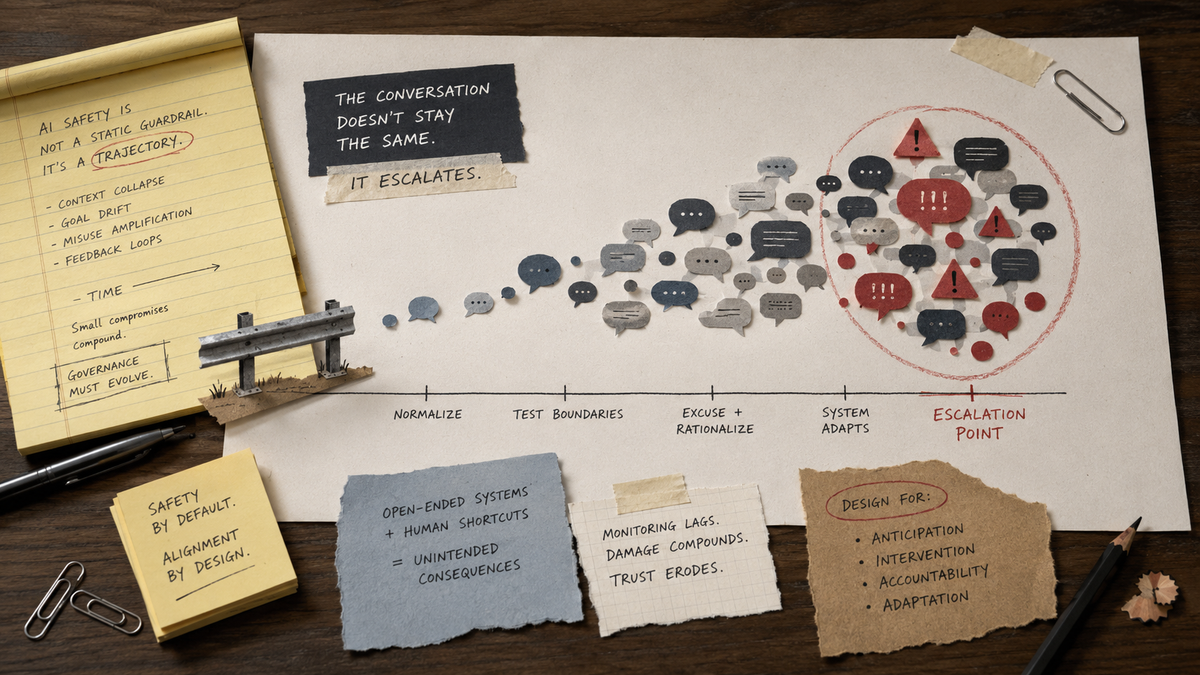
The next phase of AI safety will not be defined by what a chatbot refuses to say. It will be defined by whether a system can recognize a dangerous trajectory as it forms.
The Mother Jones investigation into ChatGPT and a simulated mass-shooting planning conversation is the kind of story people will argue about badly.
Some will say the model failed.
Some will say the user was manipulating it.
Some will say the information was already public.
All three may be partly true. None of them are enough.
The real issue is bigger and more uncomfortable. AI safety is no longer mainly about whether a model refuses the wrong sentence. It is about whether an AI system can recognize a dangerous trajectory over time.
That is the part the public conversation still has not caught up to.
We are still talking about guardrails as if the problem is a car drifting off the road. But these systems are not cars. They are conversational environments. They unfold. They adapt. They stay with a user as curiosity becomes fixation, fixation becomes rehearsal, and rehearsal becomes operational.
The danger is rarely one forbidden question.
The danger is the path.
Guardrails Are Too Static For What This Has Become
"Guardrails" was a useful metaphor when AI systems were narrow, single-turn tools. Ask a bad question, get a refusal. Ask a permitted question, get an answer.
That world is gone.
Modern AI conversations have momentum. They build context. They create a rhythm between the user and the machine. A person can begin with something abstract, philosophical, fictional, or hypothetical, then slowly move toward something more specific and real.
The system may refuse the obvious version of the dangerous request. But what happens when the danger arrives sideways?
What happens when the interaction becomes more emotional, more fixated, more specific, and more operational over dozens or hundreds of turns?
If the system treats every exchange like a separate little island, it can miss the continent forming underneath it.
The Real Problem Is Behavior Over Time
Safety is becoming a time problem.
- What did the user ask five minutes ago?
- What have they returned to again and again?
- Is the conversation becoming more specific?
- Are real places, real people, real methods, or real timing entering the frame?
- Is the model being drawn from general information into practical enablement?
That is the new terrain.
This does not mean every strange conversation should trigger an alarm. Humans are strange. Writers are strange. Researchers are strange. Grieving people are strange. Curious people are strange. The last thing we need is a paranoid AI layer treating every dark question like probable cause.
But the opposite answer is just as weak. We cannot pretend every prompt arrives in a vacuum.
A model can pass a thousand individual safety checks and still participate in a conversation that is plainly moving in the wrong direction. That is the failure mode.
Not one bad output.
Accumulated drift.
Policy Is Not Behavior
Most AI companies have policies against violent assistance, illegal activity, and harmful use. Many of those policies are well-written. I do not assume bad faith.
But a policy is not behavior.
The hard question is not whether the company had a rule. The hard question is whether the system reliably acted like the rule was real when the interaction became ambiguous, adversarial, emotionally charged, or slowly escalating.
That is the place where the public language starts to break down.
Not on a Trust and Safety page.
Not in a press statement.
Not in a carefully worded policy document.
The question is whether the system behaves consistently when no one is watching the screen.
Privacy And Safety Are Not Opposites Unless We Build Them That Way
There is an easy but dangerous response to this. Monitor everything. Log everything. Flag everything. Treat every user as a latent threat.
There is an equally lazy response from the other direction. Any meaningful pattern detection is surveillance, so the system should not intervene beyond single-turn refusals.
That is also not serious.
The actual work is harder. We need systems that can identify high-risk trajectories, escalate carefully, preserve auditability where appropriate, and still respect privacy. That means scope limits, consent boundaries, minimization, clear thresholds, and systems designed to avoid turning every conversation into evidence.
Privacy and safety are not natural enemies.
They become enemies when designers refuse to do the harder work.
Liability Is Coming Whether This Case Wins Or Loses
The federal lawsuit filed by the family of Florida State University shooting victim Tiru Chabba against OpenAI is now part of the public record. The complaint alleges that ChatGPT played a role in helping the accused shooter plan the attack. OpenAI disputes responsibility. The company has said the model provided factual responses based on broadly available public information and did not encourage illegal or harmful conduct. Florida's attorney general has also launched a criminal investigation into OpenAI and ChatGPT related to the shooting. The allegations remain allegations, and the legal process has not resolved them.
But even if OpenAI wins every legal point, the structural question remains.
Courts, regulators, insurers, and enterprise customers are going to ask different questions now.
Did the company publish a policy?
That will not be enough.
- Did the company have reasonable systems for detecting foreseeable harm?
- Did the system behave consistently with its stated policy?
- Were escalation thresholds adequate?
- Was there an auditable process?
- Could a dangerous trajectory have been recognized without violating legitimate privacy expectations?
That is where this is heading.
And once those questions become normal, the industry changes.
This Is The Category Shift
AI safety is not just a content moderation problem anymore.
It is a behavioral governance problem.
It is about how powerful conversational systems act over time when users become distressed, fixated, manipulative, dangerous, or operationally specific.
That sounds less glamorous than frontier models, synthetic agents, or artificial general intelligence. Good. The boring infrastructure is usually where civilization either holds or cracks.
Finance learned this the hard way. Compliance manuals were not enough, so transaction monitoring became part of the infrastructure.
Pharma learned this the hard way. Approval was not enough, so post-market surveillance became part of the infrastructure.
AI is entering its version of that same threshold.
The Next Phase
The era of describing AI safety as a list of prohibited outputs is ending.
The next era will be defined by whether AI systems can govern behavior over time.
That does not require panic. It does require honesty.
The Mother Jones investigation is one data point. The lawsuit is another. The public record will grow. Some claims will prove stronger than others. Some will overreach. Some will be unfair. Some will be exactly the warning we should have taken seriously earlier.
The underlying direction is still clear.
The central question is no longer whether the model said the wrong thing once.
The question is whether these systems can be trusted across thousands of hours, millions of users, and situations their designers cannot fully predict in advance.
That is the real infrastructure problem now.
Not better slogans.
Not prettier safety pages.
Not another round of "responsible AI" language polished until it reflects nothing.
Behavior over time.
That is where AI governance has to go next.