CEASEFIRE STRAINS. SECURITY SHOCK. SAHEL PRESSURE RISES.
SpinDelta | Verified Signal Brief
April 26, 2026
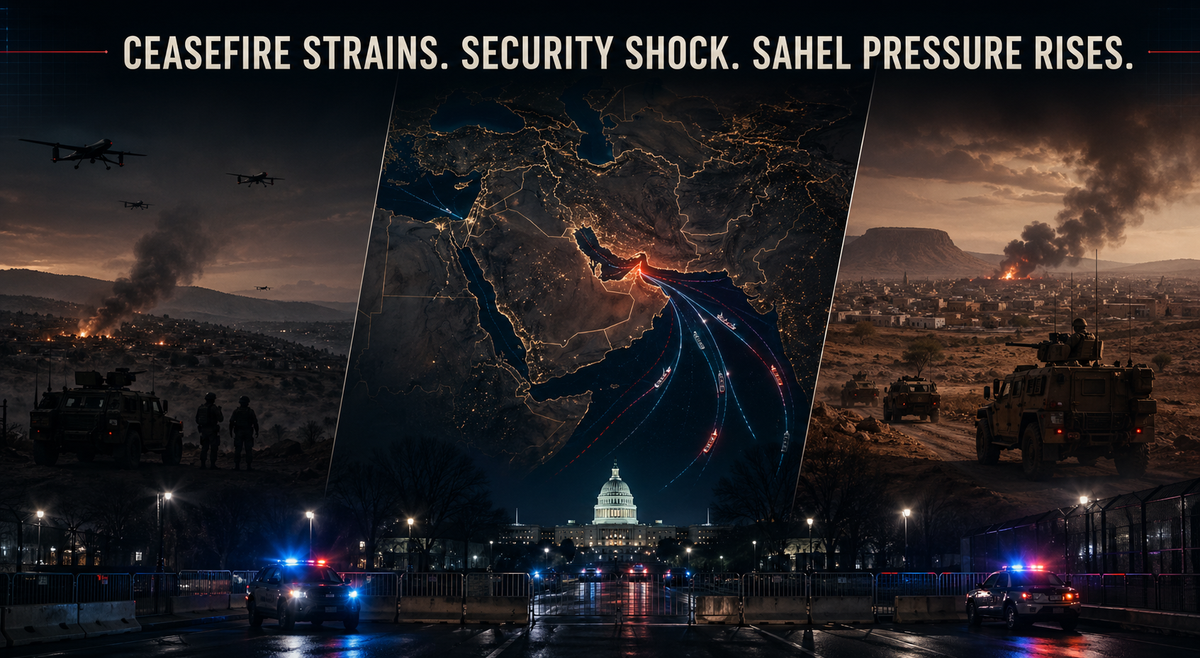
CEASEFIRE STRAINS. SECURITY SHOCK. SAHEL PRESSURE RISES.
Today’s run is degraded, but not empty. The engine bundled several stories into low-coherence clusters, so the correct move is not to publish the clusters as given. The correct move is to separate what survives.
Three signals are worth tracking.
1. Lebanon ceasefire degradation
The Lebanon ceasefire remains formally alive, but operationally strained.
Reuters reports that Israel issued evacuation warnings for seven Lebanese towns after an Israeli soldier was killed. Reuters also notes that the ceasefire has reduced but not stopped attacks, Hezbollah says it will continue fighting Israeli troops in Lebanon, and Israel says it will strike Hezbollah threats.
This is not a confirmed ceasefire collapse.
It is a ceasefire whose field reality is degrading.
2. Mali insurgency escalation
Mali may be the most underpriced signal in this run.
Reuters reports that Mali’s defense minister Sadio Camara was reported killed in a major assault by the al Qaeda-affiliated JNIM near Kati, outside Bamako. AP reports coordinated attacks by separatist and jihadi forces across Mali, including Bamako and northern towns.
This is not routine instability. It is pressure on the security architecture of Mali’s ruling junta.
The missing frame to watch: Russia. Camara was central to Mali’s pivot away from Western allies and toward Russia. If Mali’s security model is under stress, Russia’s role becomes part of the story whether it appears in every article or not.
3. White House Correspondents’ Dinner security incident
The WHCD incident is a contained but symbolically important U.S. security event.
The Washington Post reports that Cole Tomas Allen, 31, bypassed a Secret Service checkpoint, moved toward the ballroom, and was armed with a shotgun, handgun, and knives. A Secret Service officer was injured, and attendees sheltered during the incident. A separate Washington Post report says a statement attributed to Allen indicated intent to target people connected to the Trump administration.
This should not be inflated into a broad domestic-instability claim yet.
But it should be tracked as a political-security signal.
Analytical read
From a power-and-control perspective, today’s signals show authority being tested at different scales: a ceasefire framework in Lebanon, junta security in Mali, and event security in Washington. Control exists, but it is being forced to prove itself.
From a system-stability perspective, this is not synchronized collapse. It is localized stress exposure. Systems remain functional, but their enforcement margins are thin.
From a strategic-posture perspective, actors are reactive. Israel and Hezbollah are operating inside a ceasefire that neither side appears to treat as settled. Mali’s junta faces a direct challenge to its security architecture. The United States faces a contained but highly symbolic security breach.
From an operational-reality perspective, Lebanon and Mali are the hard edges. In Lebanon, the ceasefire label is diverging from events on the ground. In Mali, coordinated attacks and the reported death of the defense minister point to a major escalation.
From an infrastructure-and-energy perspective, today’s risk is not only about oil or shipping. Infrastructure also means the places where power must physically hold: border towns, military bases, political venues, and capital approaches.
Bounded projection
If Lebanon sees continued attacks under the extended ceasefire, the likely next phase is not formal collapse, but progressive ceasefire hollowing: diplomacy says one thing while the field says another.
If Mali sees continued coordinated attacks near major military or political centers, the junta’s Russia-aligned security model moves from stressed to visibly tested.
Bottom line
Today is not a clean signal day.
It is a pressure day.
The useful read is not that everything is breaking. It is that multiple systems are being forced to reveal whether their control mechanisms still work.
Special addition:
Today’s geopolitical signals point to a broader pattern: when markets transition from fragmentation to legitimacy, control tends to follow structure.
Cannabis is now entering that phase.
The move toward Schedule III is being interpreted as progress—and in many ways, it is. But it also creates a new regulatory center of gravity at the federal level. History suggests that when that happens, the next question is not whether the market grows, but who is positioned to shape and operate within the new system.
What follows is a grounded look at that transition—not as a prediction, but as a structural risk. The path forward for cannabis is still open. Whether the industry defines it, or has it defined for it, remains unresolved.
The Standardization Trap
Why Schedule III Could Become an Existential Risk to the Structure of the U.S. Cannabis Industry
This is a love letter to the cannabis industry, and a warning.
I spent years helping to build this industry. I know the people who took the risks, carried the stigma, built companies under impossible conditions, raised capital when banks would not touch the sector, dealt with shifting state rules, survived 280E, and kept going while federal law treated them as traffickers.
That history matters.
The people who built the cannabis industry deserve respect. They also deserve honesty.
Schedule III is being treated by many as a victory. In some ways, it is. It signals federal acknowledgment of medical value. It may create a path toward relief from 280E. It reflects a reality the state markets proved long ago: cannabis is not going away.
But Schedule III is not just reform.
It is a jurisdictional shift.
And jurisdictional shifts do not simply change rules. They change who is best positioned to operate under those rules.
The risk is not that cannabis gets shut down.
The risk is that cannabis gets redefined.
If the industry does not come together now, self-regulate seriously, develop a coherent national framework, and speak with one disciplined voice, it may find that the future of cannabis is written by other industries with more money, more political experience, and deeper relationships inside regulated markets.
I am not saying this will happen.
I am saying the path is now visible.
And once the path is visible, serious people should treat it seriously.
What Has Actually Changed
The immediate federal shift is narrower than many headlines suggest.
Schedule III does not broadly legalize adult-use cannabis. It does not automatically settle the status of every state-licensed cannabis business. It does not eliminate all uncertainty around federal law. What it does is create a new federal center of gravity around cannabis as a medically recognized product category subject to federal oversight, compliance, and standardization.
That matters.
The 280E issue is also critical, and the industry needs to handle it with precision. Schedule III should create a path to relief from Internal Revenue Code 280E for businesses no longer considered to be trafficking in Schedule I or II substances. But timing, scope, retroactivity, and adult-use applicability remain unresolved.
That uncertainty is not a footnote. It is a major strategic issue.
If I were helping set the industry’s federal agenda right now, retroactive 280E relief would be near the top of the list. The strongest position would be to seek relief back to the beginning of state-legal operations. If that is politically impossible, the industry should still fight for three to five years of retroactive relief.
That money matters.
State-licensed operators carried the burden of federal inconsistency for years. They paid taxes under a regime that treated them unlike almost any other lawful business operating under state law. If federal policy now acknowledges that cannabis belongs in a different category, the industry should not quietly accept a future-only correction without making the case for some retroactive repair.
Short-term tax relief could strengthen operators.
Long-term federal standardization could still reshape who controls the industry.
Both things can be true.
A Market Built Without a Governing System
The state markets proved demand.
They did that beyond serious dispute.
Depending on the estimate, the total U.S. cannabis market, legal and illegal combined, is already a tens-of-billions-of-dollars market. The legal industry has grown into a major commercial category. But the illegal market has not disappeared. It remains massive.
Here we need to be careful with numbers.
Different analysts use different methods, different years, and different definitions. BDSA’s more recent estimate places the illicit market around $40 billion. New Frontier Data previously estimated roughly $66 billion. Whitney Economics estimated that a very large share of a roughly $100 billion total market remained illicit in 2021.
Those numbers should not be blended carelessly into a false consensus. They do not all measure the same thing in the same way at the same time.
But the core conclusion is still clear:
No credible estimate places the illicit cannabis market below massive scale.
The methodological disagreement is itself part of the signal. It tells us that the illegal market is opaque, persistent, hard to measure, and structurally embedded.
That matters because the legal cannabis industry is not simply replacing the illicit market in a clean handoff. The United States is building a legal cannabis market beside a very large illegal one.
California is the warning label.
In the most mature cannabis market in the country, official state market analysis estimated that the licensed market supplied only about 38 percent of in-state cannabis consumption in 2024. The remainder was supplied through unlicensed channels. The same analysis identified taxes, fees, and regulatory costs as major burdens, especially for smaller operators.
That is not a side issue.
That is the core problem.
The black market is the primary competitor to the regulated cannabis market right now. It has lower costs, no 280E problem, no comparable compliance burden, no state licensing overhead, no testing costs, and no equivalent tax structure. It is eating the regulated market’s lunch because it does not carry the obligations imposed on legal operators.
Federal and state alignment could reduce the illicit market. If federal agencies, Treasury, DEA, FBI, state regulators, and state law enforcement finally align around banking, enforcement, taxation, access, and rational legal-market support, then the illegal market can be reduced.
Alcohol history shows that legal regulated markets can displace illegal markets over time.
But that only happens if regulation strengthens legal operators instead of burying them.
If federal standardization adds cost without improving access, banking, taxation, enforcement, and price competitiveness, then the black market will continue to thrive while licensed operators absorb the burden.
That is not reform.
That is malpractice disguised as order.
The Industry’s Self-Inflicted Exposure
This is the part the industry has to be willing to say out loud.
Cannabis proved demand.
It did not prove discipline at the national level.
The industry still lacks a national self-regulatory body with real authority and real consequences. It lacks unified standards for product definitions, cannabinoid and terpene classification, dosage equivalency, labeling, testing, and naming conventions. A consumer may buy a product under the same strain name or brand reference in different states and receive materially different products.
That is a real problem.
The industry has also allowed obvious political vulnerabilities to persist. Products that look too much like candy. Inconsistent approaches to child safety. Exaggerated potency claims. Uneven testing standards. Fragmented marketing norms. No truly unified parent-education campaign. No national public-health voice with enough credibility to shape the debate before opponents define it.
The alcohol industry did this differently.
Alcohol built institutions. DISCUS, the Beer Institute, the Wine Institute, and other bodies spent decades developing codes, advertising standards, responsibility campaigns, category norms, and public-facing language. Those systems are imperfect, but they exist. They give the alcohol industry a way to say, “We regulate ourselves. We take responsibility. We understand public health. We can be trusted inside a regulated framework.”
Cannabis does not yet have the equivalent.
That gap is dangerous.
The cannabis industry has trade associations. It has advocacy groups. It has smart operators. It has committed people. But it does not have a unified, well-funded, nationally authoritative self-regulatory structure with teeth.
That failure creates exposure.
It allows others to say, credibly, that the industry is fragmented, inconsistent, and not yet mature enough to define its own national standards.
That is the opening.
The Standardization Wedge
The strongest argument against the current cannabis structure is not prohibition.
It is consistency.
If a consumer buys wine labeled Malbec, the category has a shared meaning. If a consumer buys an IPA, the category has recognizable boundaries. The product may vary by producer, but the consumer is not operating in total semantic fog.
Cannabis does not yet have comparable national product language.
If someone walks into a dispensary in Las Vegas and buys a product under a name they recognize, then buys something under that same name or reference in New York, New Jersey, Maine, Ohio, or Colorado, they may believe they are buying the same thing.
They may not be.
The cannabinoid profile may differ. The terpene profile may differ. The genetics may differ. The cultivation method may differ. The testing standard may differ. The contaminant threshold may differ. The label may mean something different under a different state regime.
That is not just confusing.
It is exploitable.
The standardization argument writes itself:
If cannabis has accepted medical use, and if consumers cannot rely on consistent composition, testing, labeling, potency, or product identity across jurisdictions, then national standards become a consumer-protection necessity.
That argument is not ridiculous.
It is reasonable.
That is exactly why it is dangerous.
The future capture argument will not need to say, “Let alcohol control cannabis.” It will say, “Consumers deserve consistency, safety, traceability, and trust.”
That language will work with regulators.
It will work with legislators.
It will work with parents.
It will work with the press.
And if the cannabis industry does not answer that argument first, someone else will.
Why Alcohol Has Both Incentive and Capability
Alcohol is not collapsing because of cannabis. That would be too broad and too easy to attack.
But alcohol is under pressure, and cannabis competes for some of the same use occasions: relaxation, socialization, mild intoxication, sleep, stress relief, ritual, and the end-of-day transition from work to release.
Cannabis does not need to replace alcohol to threaten it.
It only needs to take a fraction of its moments.
Alcohol categories have shown pressure. Beer volumes have weakened. Wine consumption has softened. Spirits have faced recent declines. Younger consumers are drinking differently than prior generations. Cannabis is not the only cause. Health trends, demographics, pricing, social change, and post-pandemic behavior all matter.
But cannabis is part of the substitution story.
Research shows evidence of both substitution and complementarity between cannabis and alcohol. That nuance matters. Some consumers use both. Some substitute one for the other. The point is not that cannabis is the sole driver of alcohol weakness. The point is that cannabis is now competing for occasions alcohol once owned more securely.
That gives alcohol a reason to care.
Alcohol also has the machinery.
It understands distribution. It understands lobbying. It understands age-gating. It understands federal-state coordination. It understands advertising codes. It understands public-health positioning. It understands how to shape regulated markets while appearing to support responsible regulation.
This is not a claim that alcohol is currently executing a coordinated takeover plan.
No such claim is necessary.
The point is more sober and more important:
Alcohol has motive, capital, experience, relationships, and a plausible pathway.
If the alcohol industry wanted to shape cannabis regulation, the strategy is already visible. Fund research. Support consumer-protection campaigns. Promote model standards. Emphasize inconsistency. Highlight youth exposure. Point to the black market. Argue for a national framework that rewards scale, compliance, controlled distribution, and established regulated-product expertise.
That would be hard to beat unless cannabis organizes now.
The Political Mechanism
Modern regulatory capture does not require a cartoon villain.
It requires aligned incentives, credible policy language, institutional money, and patience.
The pathway could look like this:
- Motive. Alcohol sees cannabis taking some share of relaxation, social, and intoxicating-use occasions.
- Capital. Large alcohol incumbents have multi-billion-dollar balance sheets and the ability to fund long-cycle policy work.
- Vehicle. Super PACs, 501(c)(4)s, donor-advised structures, trade coalitions, and issue-advocacy groups can move money into policy debate through legally available channels.
- Proxy structure. A funded policy entity can use credentialed researchers, former regulators, public-health voices, and consumer-safety advocates. Their credibility may be real. Their work may be sincere. The funding architecture may still shape which questions get asked.
- Content. The cannabis industry’s weaknesses are not fabricated. Labeling inconsistency, potency variance, contaminant testing differences, fragmented self-regulation, illicit-market persistence, and youth-safety concerns are real issues.
- Recommendation. The policy paper does not need to say, “Give cannabis to alcohol.” It only needs to recommend a framework that structurally favors large regulated-product incumbents: federally standardized products, GMP-equivalent cultivation, national brand consistency, controlled retail environments, strict compliance systems, and capital-intensive transition requirements.
- Ratchet. Existing operators can be offered token grandfathering. The grandfather path can preserve the appearance of continuity while imposing compliance burdens calibrated to large-company capital structures.
- Catalyst. Schedule III creates the federal regulatory surface that makes this pathway newly viable. Before rescheduling, federal cannabis policy was constrained by Schedule I prohibition. After Schedule III, agencies including DEA, FDA, HHS, Treasury, and IRS all become more relevant to the future architecture.
That is the mechanism.
This does not allege that any specific actor is already executing it.
It does not require that allegation.
The standard for raising structural risk is not proof that the risk is already underway. The standard is whether the pathway is viable, whether actors have motive and capital, and whether the catalyst has occurred.
Here, all three are present.
Precedent: Compliance as Market Redesign
This pattern has happened before.
The vaping market is one of the clearest analogues. Federal authorization requirements created a pathway where the lawful market narrowed dramatically, while illicit or unauthorized products continued to circulate. A compliance framework justified by public health did not simply regulate the market. It changed who could afford to remain in it.
Online gambling after UIGEA offers another example. A payments-and-compliance intervention rapidly changed the market structure and forced major operators out of the U.S. market.
Cannabis is not vaping.
Cannabis is not online gambling.
The analogy is not identity.
The point is structural: when a gray, fragmented, or legally ambiguous market is pulled into a high-compliance federal framework, the winners are usually the actors with capital, lawyers, lobbyists, compliance teams, and regulatory fluency.
That is not morality.
It is mechanics.
A Third Structural Pressure: Sovereign Markets
There is another pressure the industry must take seriously: Native American sovereign cannabis markets.
Tribal operators may operate under distinct legal and tax frameworks. Depending on structure, they may carry lower tax burdens and different regulatory obligations than state-licensed operators. That can create substantial margin advantages.
This is not an argument against Native American participation. Sovereignty is real. Tribal economic development is legitimate. Native American actors have every right to pursue lawful economic opportunity within their own frameworks.
But from a market-structure perspective, sovereign markets add another competitive layer.
If state-licensed operators are burdened by high taxes, 280E uncertainty, testing costs, licensing fees, and compliance obligations while competing against illicit markets and lower-burden sovereign markets, the regulated state operator becomes increasingly exposed.
That exposure must be part of any serious analysis.
The Ten-Year Transition Risk
The risk does not require an overnight shutdown.
It could unfold gradually.
First, Schedule III establishes federal medical legitimacy.
Second, studies emphasize inconsistency, illicit-market persistence, youth exposure, testing variation, potency confusion, and consumer-protection gaps.
Third, national voluntary standards are proposed.
Fourth, banks, insurers, distributors, regulators, and institutional partners begin favoring operators that meet those standards.
Fifth, voluntary standards become practical requirements.
Sixth, federal-state harmonization creates a new compliance architecture.
Seventh, existing operators are offered a grandfather path that is technically available but economically unrealistic.
Eighth, large alcohol, tobacco, pharmaceutical, pharmacy, or national consumer-goods players enter through partnerships, acquisitions, compliant distribution platforms, or federally preferred product frameworks.
No one has to say legacy operators are banned.
They can simply make survival expensive.
What Makes This Existential
This is not an existential threat to cannabis demand.
Cannabis demand is real.
This is not even necessarily an existential threat to cannabis as a product category.
Cannabis will survive.
The question is who survives as an operator.
The threat is existential to the current structure of the adult-use and medical cannabis industry: small operators, independent dispensaries, state-fragmented business models, undercapitalized brands, and companies that survived prohibition but may not survive standardization.
Schedule III does not guarantee that outcome.
But it makes the pathway visible.
And once the pathway is visible, the industry should not pretend it cannot happen.
The Counterbalance
Standardization is not inherently bad.
In many industries, it improves safety, consistency, consumer trust, insurance access, banking access, and interstate commerce.
Cannabis needs standards.
Cannabis needs better labeling, stronger testing integrity, better public-health messaging, clearer product definitions, and more disciplined consumer education.
The question is not whether cannabis should mature.
It must.
The question is whether cannabis will mature itself, or whether maturity will be imposed by better-funded actors with different incentives.
The Industry’s Choice
The cannabis industry still has agency.
It can treat Schedule III as a victory lap.
Or it can treat it as a warning bell.
The industry should immediately consider:
- Creating a national self-regulatory body with real enforcement power.
- Funding unified public-health and parent-education campaigns.
- Establishing national product and labeling standards.
- Developing cannabis-specific category language that consumers can trust.
- Coordinating legal and tax strategy around 280E, including retroactivity.
- Building a serious federal-state illicit-market reduction strategy.
- Creating political infrastructure capable of answering alcohol-scale capital.
- Presenting a unified vision for standardization before outsiders define it.
This will require money.
Tens of millions of dollars may be necessary.
But the cost of inaction may be higher.
If alcohol, tobacco, pharma, pharmacy, or any other adjacent regulated industry decides to move seriously, they will not need to invent the playbook. The playbook is sitting in plain sight. It is made of consumer protection, consistency, safety, standardization, and public trust.
Those are good words.
They can also become weapons.
A Love Letter and a Warning
The people who built this industry deserve more than applause.
They deserve a chance to survive the next phase.
That will not happen automatically.
The first generation of cannabis operators survived illegality.
The next generation may have to survive legitimacy.
Schedule III opens a window. It does not determine the outcome.
But if the industry fails to organize, fund, self-regulate, and speak with a credible national voice, the future framework may be written by others.
The question is not whether cannabis becomes legitimate.
The question is who legitimacy will belong to.