FRAGILE CEASEFIRE. ACTIVE PRESSURE. U.S. STEPS IN. TENSIONS REMAIN.
SpinDelta | Verified Signal Brief | April 19, 2026
Core Signal
The most defensible signal today is not resolution, but strain under control.
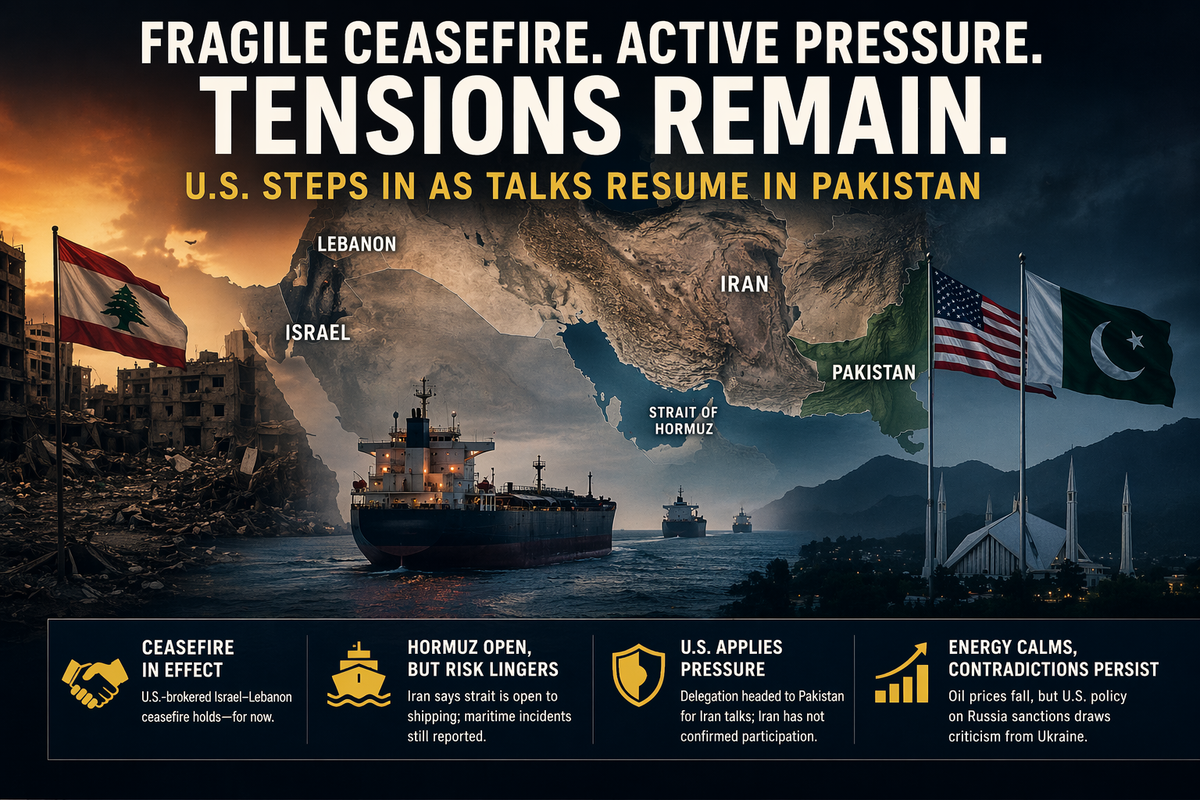
The Israel–Lebanon ceasefire remains in effect following April 16 implementation, with the United States publicly asserting pressure to maintain it. At the same time, the broader Iran-linked environment shows signs of instability: reported maritime tension in the Strait of Hormuz, ongoing U.S. blockade conditions, and uncertain participation in renewed negotiations expected in Pakistan.
The situation is best understood as:
A fragile ceasefire environment being actively managed under coercive conditions
What is verified
- A U.S.-brokered Israel–Lebanon ceasefire took effect April 16.
- U.S. leadership publicly stated Israel was not to continue bombing Lebanon.
- Iran indicated the Strait of Hormuz is open to commercial shipping during the ceasefire window.
- Oil prices moved sharply lower following that announcement.
- The U.S. blockade on Iranian ports remains in place.
- A U.S. delegation is expected to travel to Pakistan for renewed Iran talks; Iran has not confirmed participation.
What remains uncertain
- Whether the ceasefire will hold beyond the immediate window
- Whether maritime incidents represent isolated events or escalation
- Whether negotiations in Pakistan will materialize with both parties present
- Whether current U.S. pressure reflects a temporary intervention or a broader shift in alliance posture
Analytical Perspectives
Power and Control Perspective
This is not a negotiated peace—it is active containment.
The United States is exerting visible influence to prevent escalation, including constraining an ally’s operational behavior. This reflects a system under stress where unmanaged conflict is no longer acceptable.
System Stability Perspective
The system is less volatile, but not stable.
The reopening of Hormuz reduced immediate market panic, but the coexistence of open shipping and active blockade indicates unresolved structural tension beneath surface calm.
Strategic Posture Perspective
Washington is operating in a dual-pressure mode:
- restraining Israeli escalation
- maintaining leverage against Iran
This reflects a short-term stabilization posture rather than a settled strategic doctrine.
Battlefield Reality Perspective
The ceasefire is real but fragile.
Early-stage ceasefires are characterized by:
- incomplete compliance
- rapid reversibility
- continued signaling from all actors
This is a holding pattern, not a resolution phase.
Infrastructure and Energy Perspective
Immediate disruption risk has declined, but system vulnerability persists.
Energy flows have stabilized temporarily, yet maritime risk and blockade conditions continue to define the underlying structure.
Adjacent System Tension
Separately, U.S. policy is creating tension within the same energy system it is attempting to stabilize.
The extension of waivers affecting Russian oil flows has drawn criticism from Ukraine, highlighting a contradiction:
- short-term energy stabilization
- versus long-term geopolitical alignment
This does not alter the core signal, but it reinforces that:
the global system is stabilizing tactically while remaining strategically misaligned
Integrity Notes
- No unverified entities included
- No narrative inflation or inferred coordination
- Secondary interpretations (legal framing, media tone) excluded from core signal
- All claims constrained to verifiable reporting and clearly labeled uncertainty
Bottom Line
This is not a moment of resolution.
It is:
externally enforced escalation control under fragile conditions—visible, active, and reversible