FRAGILE CEASEFIRE. ACTIVE PRESSURE. U.S. STEPS IN. TENSIONS REMAIN.
SpinDelta | April 17, 2026
Today’s signal is narrower than the noise around it—and more important because of that.
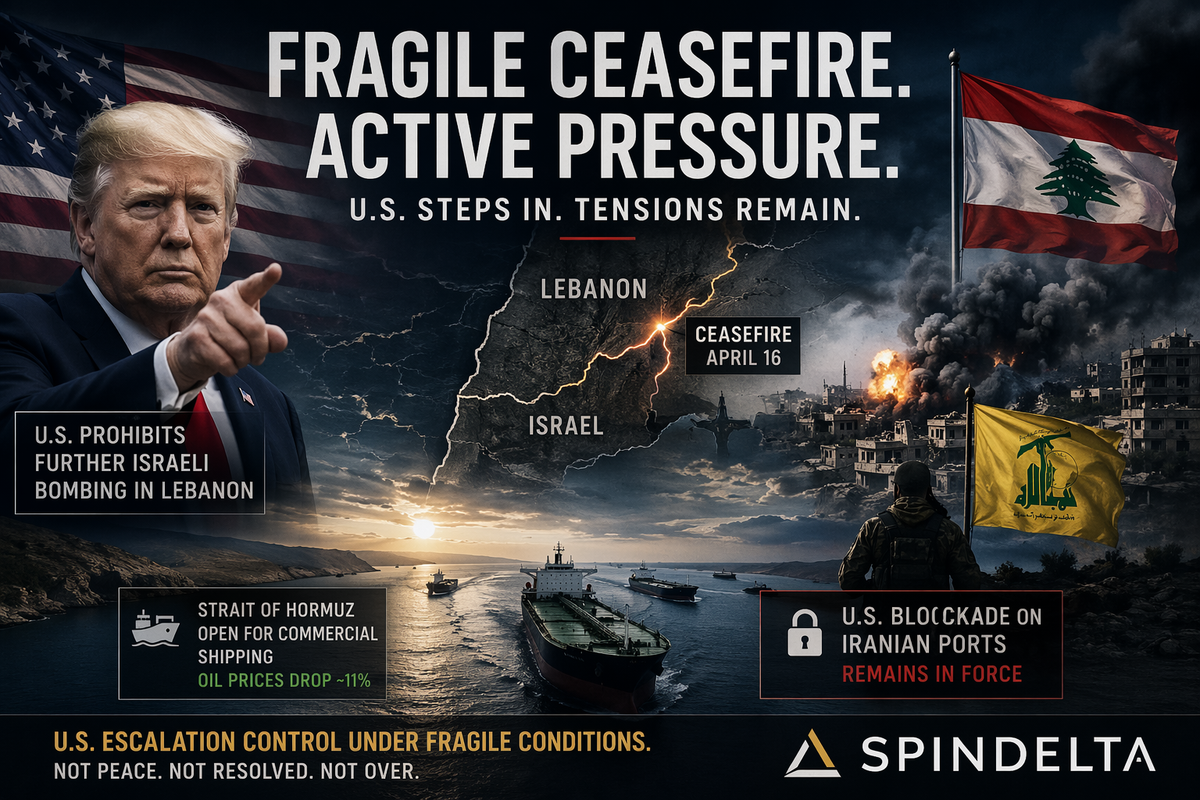
The verified story is this: the United States is publicly pressuring Israel to hold the Lebanon ceasefire, while Iran’s decision to keep the Strait of Hormuz open has sharply eased immediate oil panic—without removing the deeper pressure structure underneath.
Reuters and RTÉ report that President Trump said Israel was barred from further bombing in Lebanon after the U.S.-brokered ceasefire took effect on April 16. That matters because Washington is not just endorsing de-escalation—it is visibly inserting itself into enforcement. (reuters.com)
At the same time, Reuters reports that Iran said the Strait of Hormuz is open for commercial shipping during the ceasefire, and oil fell roughly 11% in response. But the U.S. blockade on Iranian ports remains in place. So the immediate disruption eased, while the underlying coercive structure did not disappear. (reuters.com)
How to read this
Power and control perspective
This is not a peace outcome. It is a containment move.
A dominant external actor is actively limiting escalation, including constraining an ally’s military behavior. That signals the situation has crossed a threshold where unmanaged escalation is no longer acceptable.
System stability perspective
The system is calmer than it was—but not stable.
Energy flows resumed at the surface level, reflected immediately in oil prices. But the coexistence of an open Strait and an active blockade shows the system is still under tension, not resolved.
U.S. strategic posture perspective
This is an unusual level of visible pressure inside an alliance.
Publicly restricting Israeli action suggests Washington is prioritizing regional risk control over automatic operational latitude for its partner, at least in this window.
Battlefield reality perspective
The ceasefire is real, but fragile.
Early-phase ceasefires are defined by tension, incomplete compliance, and rapid reversibility. A declared halt in action does not mean control on the ground is fully established.
Infrastructure and energy perspective
Immediate risk declined; structural vulnerability remains.
Reopening the Strait reduces short-term supply disruption risk, but ongoing blockade conditions mean the underlying system has not normalized.
What is known
- A U.S.-brokered Israel–Lebanon ceasefire took effect on April 16.
- Trump said the U.S. prohibited further Israeli bombing in Lebanon.
- Iran said the Strait of Hormuz is open to commercial shipping during the ceasefire.
- Oil dropped sharply in response.
- The U.S. blockade on Iranian ports remains in force.
What is not yet known
- Whether the ceasefire will hold beyond the immediate window.
- Whether Washington’s public pressure reflects a temporary intervention or a deeper shift in alliance dynamics.
- Whether any broader Iran deal is actually close, as opposed to being described that way politically.
Bottom line
This is not regional resolution.
It is externally enforced escalation control under fragile conditions—visible, active, and still reversible.