FRAGILE DEADLINES. ACTIVE PRESSURE. INSTITUTIONS UNDER TEST.
SpinDelta — Verified Signal Brief
April 21, 2026
Core Signals
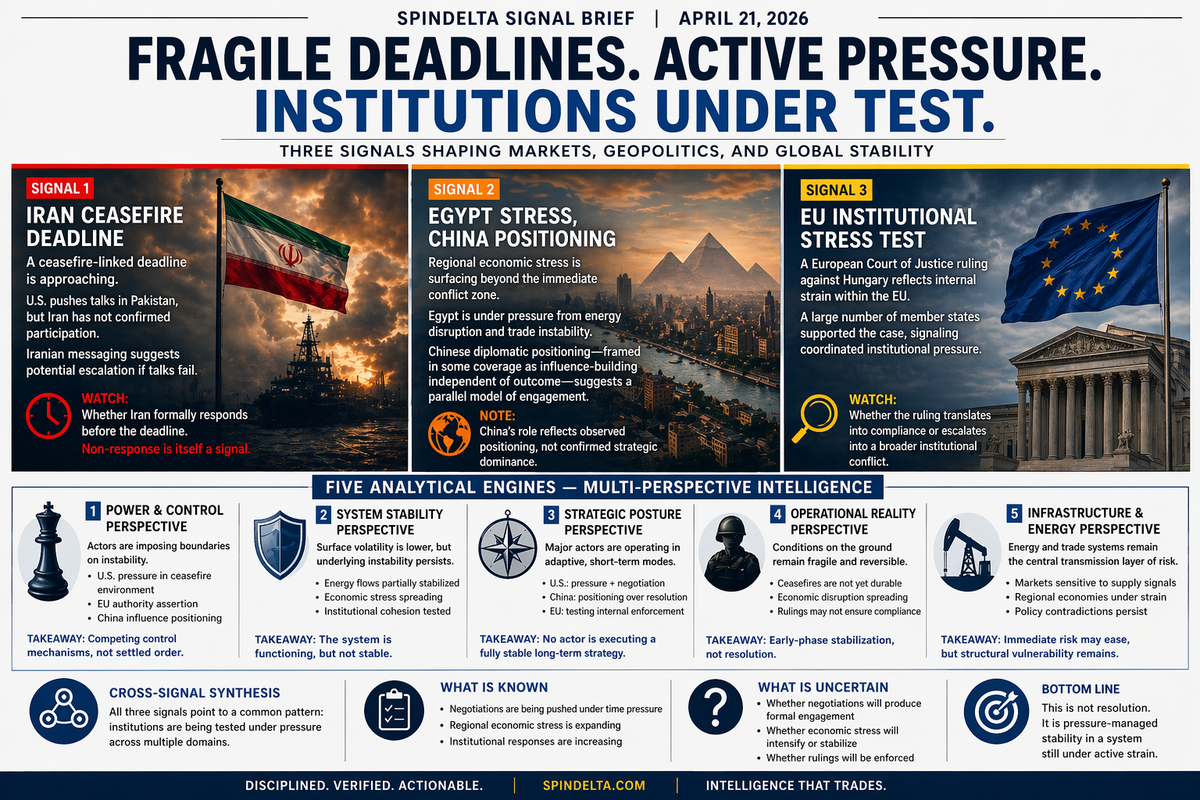
🔴 SIGNAL 1 — Iran Ceasefire Deadline
A ceasefire-linked deadline is approaching under uncertain conditions.
U.S. leadership is publicly pushing for negotiations in Pakistan, while Iran has not formally confirmed participation. At the same time, Iranian messaging suggests potential escalation if talks fail.
This is not a confirmed breakdown.
It is:
a time-bound negotiation environment under visible strain
Watch:
Whether Iran formally responds to the Pakistan talks framework before the deadline.
Non-response is itself a signal.
🟠 SIGNAL 2 — Egypt Stress, China Positioning
Regional economic stress is surfacing beyond the immediate conflict zone.
Egypt is experiencing pressure tied to energy disruption and trade instability. At the same time, Chinese diplomatic positioning—framed in some coverage as influence-building independent of outcome—suggests a parallel model of engagement.
Interpretation constraint:
China’s role should be treated as observed positioning, not confirmed strategic dominance.
🟡 SIGNAL 3 — EU Institutional Stress Test
A European Court of Justice ruling against Hungary reflects internal strain within the EU.
The notable factor is the number of member states participating in the case, signaling coordinated institutional pressure. The open question is enforcement.
Watch:
Whether the ruling translates into compliance or escalates into a broader institutional conflict.
Analytical Engine Output
1. Power & Control Perspective
Across all three signals, dominant actors are attempting to impose boundaries on instability, not resolve it.
- U.S. pressure in the ceasefire environment reflects active containment
- EU legal action reflects internal authority assertion
- China’s positioning reflects influence without direct enforcement
Conclusion:
This is a landscape of competing control mechanisms, not settled order.
2. System Stability Perspective
The system shows reduced volatility at the surface level, but underlying instability remains.
- Energy flows have partially stabilized
- Economic stress is spreading outward (Egypt)
- Institutional cohesion is being tested (EU)
Conclusion:
The system is functioning, but not stable
3. Strategic Posture Perspective
Major actors are operating in adaptive, short-term modes:
- The U.S. is combining pressure and negotiation simultaneously
- China is prioritizing positioning over resolution
- The EU is testing internal enforcement boundaries
Conclusion:
No actor is executing a fully stable long-term strategy; posture is reactive and situational
4. Operational / Ground Reality Perspective
Conditions on the ground remain fragile and reversible:
- Ceasefire environments are not yet durable
- Economic disruption is already affecting non-combatant states
- Institutional rulings may not translate into compliance
Conclusion:
Current conditions represent early-phase stabilization, not resolution
5. Infrastructure & Energy Perspective
Energy and trade systems remain the central transmission layer of risk:
- Market reactions reflect sensitivity to supply signals
- Regional economies (e.g., Egypt) are absorbing external shocks
- Policy contradictions (sanctions, trade flows) persist
Conclusion:
Immediate disruption risk may ease, but structural vulnerability remains intact
Cross-Signal Synthesis
All three signals converge on a single pattern:
Institutional systems are being tested under pressure across multiple domains
- Ceasefire frameworks → timing stress
- Regional economies → spillover stress
- Legal institutions → enforcement stress
This is not systemic breakdown.
It is:
active renegotiation of how institutions operate under strain
What is Known
- Negotiations are being pushed under time pressure
- Regional economic stress is expanding beyond conflict zones
- Institutional responses (legal, diplomatic) are increasing
What is Uncertain
- Whether negotiations will produce formal engagement
- Whether economic stress will intensify or stabilize
- Whether institutional rulings will be enforced
Integrity Notes
- No unverified claims included
- No deterministic escalation language used
- All interpretation layers clearly labeled
- Secondary framing constrained and identified
- Signals separated by coherence, not narrative convenience
Bottom Line
This is not resolution.
It is:
pressure-managed stability in a system still under active strain