STALLED CEASEFIRE. ACTIVE PRESSURE. LIMITED VISIBILITY.
SpinDelta | Verified Signal Brief
April 22, 2026
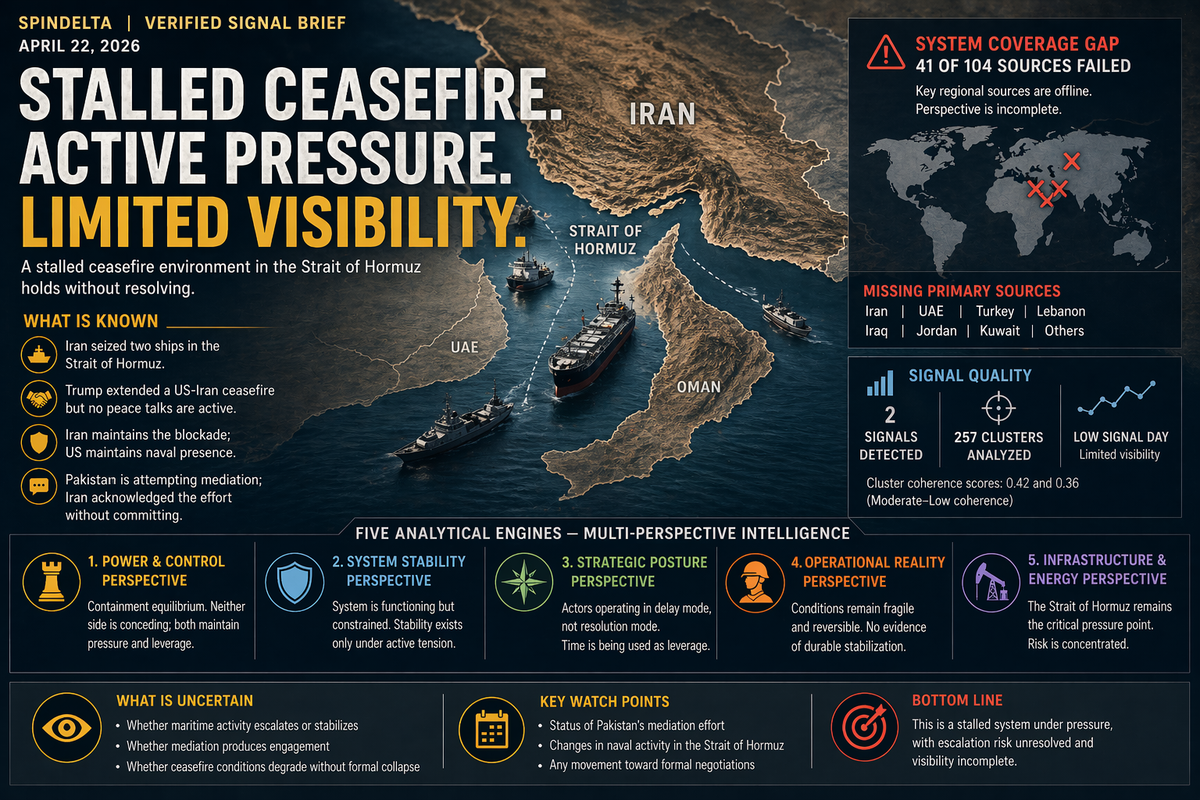
STALLED CEASEFIRE. ACTIVE PRESSURE. LIMITED VISIBILITY.
Core Signal
The dominant signal today is not escalation—but stagnation under pressure.
The Iran–Hormuz environment shows a ceasefire structure that is holding without resolving:
- Maritime tension persists in the Strait of Hormuz
- The United States maintains blockade presence
- Iran continues to use the strait as leverage
- Pakistan’s mediation is acknowledged, but not operational
This is a stable instability condition:
no breakthrough, no collapse, but continued pressure on all sides
System Constraint
This run is materially degraded.
- 41 out of 104 sources failed
- Core regional sources (Iran, UAE, Turkey, Lebanon) are missing
This means:
The signal is visible—but the perspective is incomplete
What is Known
- Maritime pressure in Hormuz continues
- Ceasefire conditions remain unresolved
- Both sides maintain leverage positions
- Mediation channels exist but lack commitment
What is Uncertain
- Whether maritime activity escalates or stabilizes
- Whether mediation produces engagement
- Whether ceasefire conditions degrade without formal collapse
Analytical Perspectives
Power & Control
This is a containment equilibrium.
Neither side is conceding; both are maintaining pressure.
System Stability
The system is functioning but constrained.
Stability exists, but only under active tension.
Strategic Posture
Actors are operating in delay mode, not resolution mode.
Time is being used as leverage.
Operational Reality
Conditions remain fragile and reversible.
No evidence of durable stabilization.
Infrastructure & Energy
Hormuz remains the critical pressure point.
Risk is concentrated, not diffused.
Bottom Line
This is not movement.
It is:
a stalled system under pressure, with escalation risk unresolved and visibility incomplete